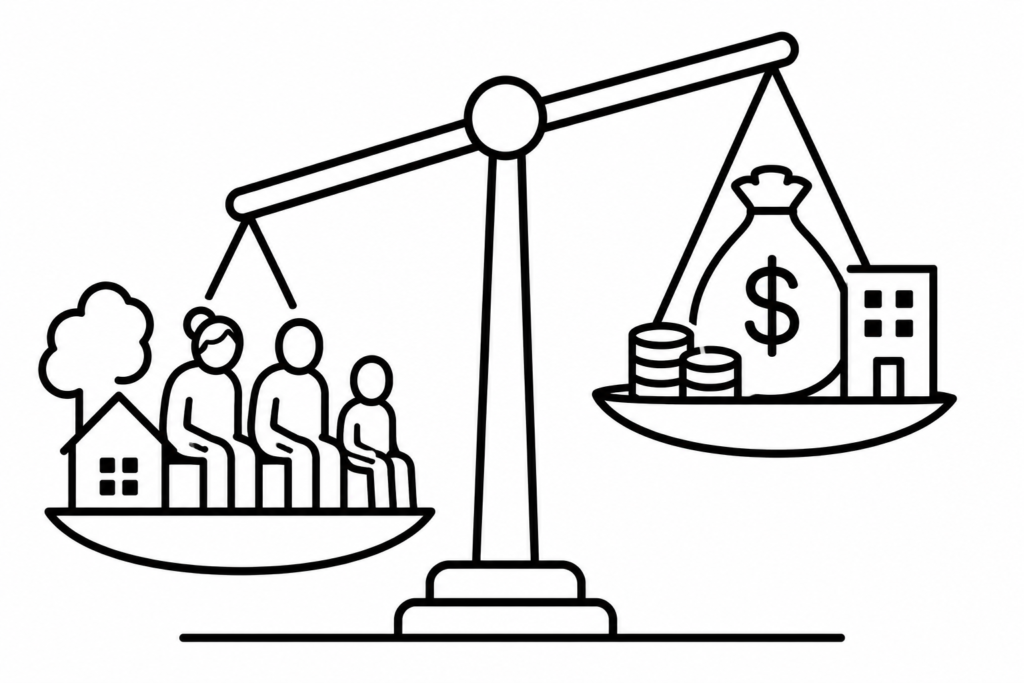
I keep hearing politicians shaped by neoliberal thinking talk about state housing and social support as if the crisis lies with the people needing help rather than with the conditions that created that need in the first place.
The language shifts from week to week, but the message rarely changes: reduce dependency, tighten eligibility, push people back into work, increase efficiency, control spending. Beneath it all sits a familiar implication that there are too many people taking and not enough people contributing. People like me quietly become part of the problem to be solved.
I live with progressive vision loss and am legally blind. This did not happen because I made poor lifestyle choices or because I suddenly decided I no longer wanted to work. For most of my life I believed in contributing, not only because I had to but because I genuinely believed in the idea of being part of something larger than myself. I have always believed we owe something to one another and that a functioning society depends on that understanding.
For three and a half decades I worked hard, mainly in hospitality. I owned businesses, employed people, paid taxes and contributed to my community. I did what we are repeatedly told we should do: work hard, participate, build something and contribute. Like most people, I assumed effort would be enough and that if I played by the rules there would be some kind of security in that.
Eventually I ran out of body before I ran out of willingness.
That is not dependency. That is wear and tear. That is life.
Nobody plans for this. Most people are probably one accident, one illness, one diagnosis or one terrible year away from standing much closer to this position than they imagine. Yet political discussion often talks about support systems as though they exist because of personal failure rather than collective reality.
The strange thing is that while public attention keeps being directed toward beneficiaries and state housing tenants, the actual pressure points in everyday life remain largely unchanged. Food prices continue to climb. Housing costs remain detached from incomes. Rent absorbs larger and larger portions of family budgets. Everyday people tighten belts already sitting on the last notch while large corporations and dominant market players continue reporting substantial profits. Still, the spotlight repeatedly circles back to those already struggling.
Part of the answer lies in a broader ideology that has shaped political thinking over recent decades: neoliberalism. Its promises sound simple enough. Markets are efficient. Competition creates better outcomes. Governments should become leaner, spend less and behave more like businesses. On paper that can sound sensible. In practice it often creates something deeply disconnected from human reality.
Countries are not businesses. Businesses exist to maximise returns. Societies exist to support human lives. The difference matters.
Governments increasingly evaluate public institutions according to the logic of markets: efficiency, cost reduction and measurable output. The problem is that many of the things we value most cannot easily be measured in those terms. What is the financial return on a hospice worker sitting beside someone who is dying? What is the economic output of legal aid keeping a vulnerable family from collapse? What is the profit margin on supporting a disabled person with housing and dignity?
Many of the things that matter most produce no obvious economic return at all. Yet most of us understand instinctively that these are among the things that make a society worth living in.
Austerity repeatedly misunderstands this. It assumes governments can reduce spending in one place without consequences appearing somewhere else. Too often it is cruelty masquerading as social responsibility, asking those with the least to carry the heaviest burden.
History suggests otherwise. Large public-sector cuts may create immediate savings, but they often generate delayed costs through unemployment, reduced economic activity, lower tax revenue, worsening health outcomes and increased pressure on support services.
The consequences are not only economic; they are political. People can only live with insecurity for so long before frustration turns into anger and trust in institutions begins to fracture. History shows that when societies create widespread uncertainty and leave people feeling abandoned, authoritarian movements are often waiting in the wings with simple answers, convenient enemies and promises to make things right. We can see versions of that story unfolding around the world, and nowhere more visibly than in the rise of right-wing authoritarian politics in America.
The bill does not disappear. It simply arrives later.
You do not eliminate cost. You relocate it. And eventually someone pays.
Sometimes that someone is a family pushed into hardship. Sometimes it is a community hollowed out by unemployment. Sometimes it is the person whose condition worsens because support arrived too late. Sometimes it is someone like me.
I did not decide to stop working and choose the supposedly comfortable path of unemployment. If there is waste here, it is not me.
What strikes me most is the distance between political rhetoric and ordinary reality. People with power discuss support systems as though they are excessive luxuries, while families survive on amounts that often seem tiny compared with the machinery surrounding them. It can begin to feel less like policy and more like abstraction: governing through graphs, spreadsheets and budget forecasts while forgetting that every number represents a person.
A healthy society is not simply an efficient one. It is a stable one. It is one where people trust that if life collapses beneath them there will be something there to catch them. I believed that too until I found myself needing it and discovered how difficult systems can become once people are reduced to numbers.
Eventually almost all of us become vulnerable. Bodies age. Accidents happen. Illness arrives. Jobs disappear. Nobody remains permanently on the winning side of fortune.
The real insanity is not that people need help. The real insanity is pretending vulnerability is some kind of moral failure. Sooner or later life humbles all of us. The question is not whether people will need support; the question is what kind of society will be waiting when they do.
Leave a Reply