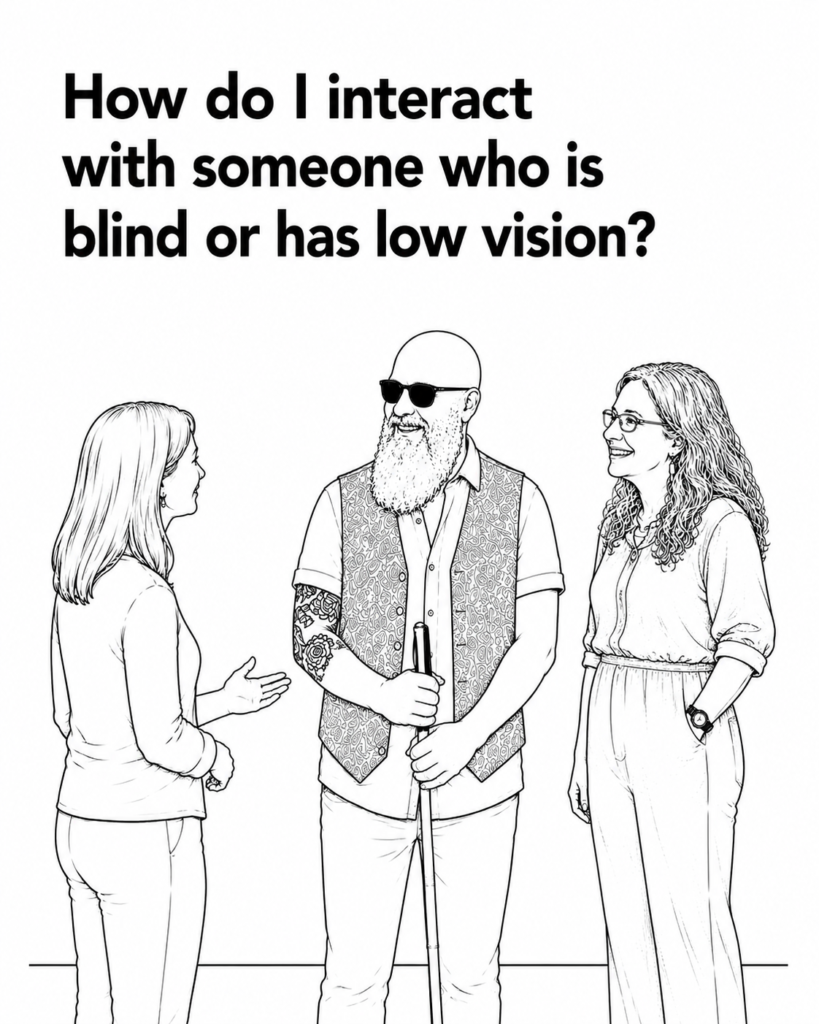
Most people don’t meet many blind people in their daily lives. As a result, they rarely have the opportunity to learn what makes an interaction helpful, what creates unnecessary barriers, and what simply makes life feel normal.
Over the years I’ve noticed something encouraging. Almost everyone wants to do the right thing. The uncertainty isn’t caused by a lack of kindness, it comes from a lack of experience.
Should I offer help?
Is it alright to say “See you later”?
Should I take someone’s arm?
How do I describe where something is?
They’re simple questions, yet many people have never had the chance to ask them.
This guide isn’t a list of rules. It’s an invitation to understand a little more about how blind and sighted people can interact comfortably and naturally. None of these ideas are difficult, but together they remove much of the awkwardness that can exist when people are unsure of what to do.
Meet the person, not the disability
When I first started losing my vision, the one thing I resisted more than anything else was being seen as a blind person.
Using my white cane in public or admitting that I could no longer recognise the faces of people I met felt like crossing a line I wasn’t ready to cross. I wanted people to meet me, not my blindness.
As it turns out, I had good reason to feel that way.
The moment people realise I’m blind, the interaction often changes. Suddenly they’re no longer meeting a person, they’re meeting a disability.
The conversation becomes cautious. Some people slow their speech, as though blindness affects hearing or cognition. Others become overly helpful, or so worried about saying the wrong thing that they stop being themselves altogether. Before we’ve even exchanged names, blindness has become the focus of the conversation.
It doesn’t have to be that way.
The most important thing to remember when meeting someone who is blind or has low vision is surprisingly simple: you’re meeting a person, not a disability.
Blindness is something I live with every day, but it isn’t the sum of who I am. I’m also a partner, a chef, a meditator, an artist, a writer, a gardener, and, according to some, a terrible singer. Like everyone else, I arrive carrying a lifetime of experiences, interests, strengths and flaws. My blindness is part of my story, but it isn’t the headline.
The challenge is that disabilities have a habit of introducing themselves before people do.
A white cane or a guide dog is highly visible. It’s natural for your attention to be drawn to it. The trick is not to let it define the person standing in front of you.
The easiest way to avoid awkwardness is simply not to think about blindness quite so much.
Talk to me the same way you would talk to anyone you’ve just met. Tell me about yourself. Ask questions. Share a laugh. If blindness becomes relevant, it will naturally find its place in the conversation. If it doesn’t, that’s perfectly okay too.
One of the greatest gifts you can offer anyone is the feeling of being seen for who they are, rather than what they appear to be.
That doesn’t mean pretending blindness doesn’t exist. It does. There are times when I’ll need information described differently, directions explained more clearly, or an offer of assistance. Those moments are practical, not defining. They’re no different from speaking a little louder to someone who is hard of hearing or holding a door open for someone carrying a heavy box.
What matters isn’t whether you acknowledge the blindness. It’s whether you allow it to become the whole person.
Meet the person first.
Let the blindness become just one chapter in the conversation, not the title of the book.
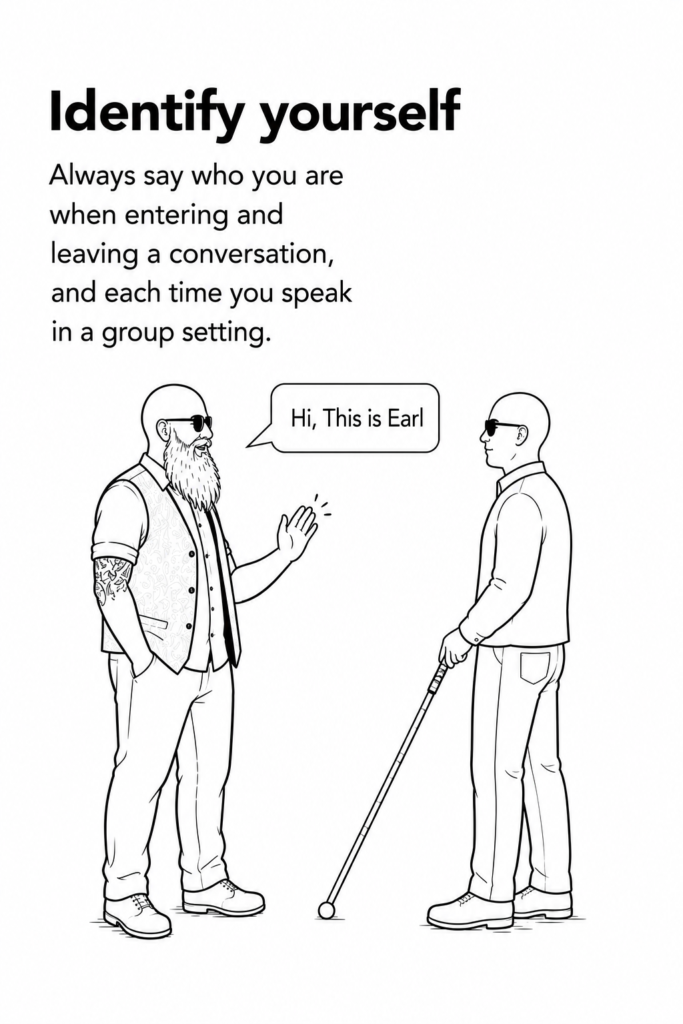
One of the simplest, and most helpful, things you can do when approaching someone who is blind or has low vision is to introduce yourself.
A simple, “Hi Earl, it’s Sarah,” immediately removes any uncertainty and allows the conversation to begin naturally. It takes only a second, yet it saves me the awkwardness of trying to work out who’s speaking.
People are often surprised when I don’t recognise them by their voice. Somewhere along the way we’ve developed the idea that blind people possess an almost supernatural ability to identify everyone from a few spoken words.
It goes hand in hand with another of my favourite misconceptions: that when you lose your sight, all your other senses somehow become magically heightened.
I’m sorry to disappoint you, but my hearing didn’t suddenly turn into sonar.
Some blind people do develop an exceptional ear for voices, just as some sighted people are naturally good at recognising faces. But for most of us, recognising someone by voice depends on countless little factors.
Voices change.
People catch colds. They speak from another room. Children chatter in the background. They whisper. They laugh. They grow older. Wind carries their words away, and busy cafés fill the air with competing conversations.
Context matters too.
If I meet a neighbour at the supermarket, I’m expecting to hear the voices of shoppers, not someone I usually chat to over the back fence. If I unexpectedly meet an old friend after several years, the voice I remember may no longer match the person standing in front of me.
It’s not that I never recognise voices.
Often I do.
It’s just that guessing can be exhausting.
Imagine spending every social interaction trying to identify people from tiny clues while hoping you don’t accidentally greet a stranger like an old friend, or, perhaps even worse, fail to recognise someone you’ve known for years.
A simple introduction removes all that uncertainty.
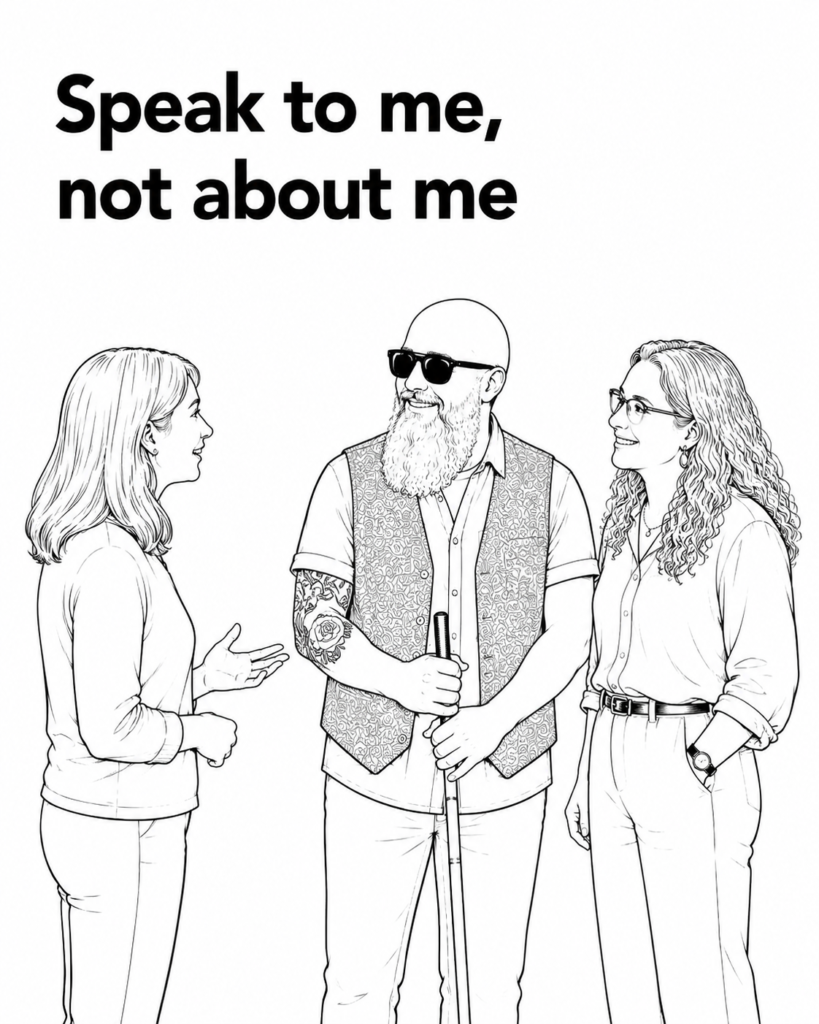
“How is he doing?”
It was a question someone once asked Shelley, even though I was standing right beside her.
This is an interaction that almost every blind person has experienced at some point, to some degree.
It is a strange feeling to become an observer in your own conversation. To be physically present, yet somehow absent from the exchange. The sense of isolation, and, perhaps more than that, the feeling of invisibility, can be surprisingly powerful.
Fortunately, this sort of thing is rarely intentional. Most people are simply trying to be polite. They worry about saying the wrong thing or assume that the person accompanying me somehow knows better than I do.
The irony is that the easiest way to avoid awkwardness is simply to speak to me.
If I’m standing there, I’m almost certainly the best person to answer your question.
Blindness affects my eyesight, not my ability to think, make decisions, or hold a conversation. If I need someone else to answer for me, I’ll ask them.
One of the unexpected consequences of losing my sight is how quickly people begin making decisions on my behalf.
Sometimes, I have to admit, it’s entirely welcome.
Walking along a busy footpath with my white cane can feel a little like being an inner-city Moses. Crowds miraculously part, creating a clear path ahead. There are moments when I could get used to that.
At other times, however, it’s decidedly less welcome.
A shop assistant tells Shelley the price instead of telling me.
A casual acquaintance asks her, “How much can he see?”
None of these moments are particularly dramatic on their own.
But together they send the same quiet message:
You’re not the main participant in this conversation.
It’s a message no one intends to send, yet it can leave someone feeling diminished all the same.
Thankfully, it’s also one of the easiest things to avoid.
If you’re speaking to someone who is blind or has low vision, face them and speak to them directly. Ask:
“How much vision do you have left?”
“How would you like me to describe this?”
“Is there anything I can help with?”
Most of us don’t expect you to know the perfect thing to say.
We simply appreciate being included in our own conversation.
One of the kindest instincts people have is the desire to help.
Unfortunately, it’s also one of the easiest instincts to get wrong.
When people see someone using a white cane, they often assume help is needed. Without thinking, they grab an arm, take hold of a shoulder, or begin steering the person in the direction they believe they should be going.
It almost always comes from a good place.
But imagine if a complete stranger suddenly took hold of you and started walking.
You’d probably be just as startled as I am.
The first rule is wonderfully simple.
Ask first.
“Would you like a hand?”
Those four words make all the difference.
They acknowledge that I have a choice. They recognise that I may already know exactly where I’m going, or that I may simply be taking a moment to listen to the traffic, orient myself, or work something out.
A white cane doesn’t necessarily mean someone is lost.
Sometimes we’re just thinking.
Sometimes we’re deciding whether the supermarket entrance is to the left or the right.
Sometimes we’re waiting for a noisy truck to pass so we can hear the pedestrian crossing.
What may look like hesitation is often careful navigation.
If the answer is, “No thanks,” don’t be offended.
Blind people spend much of their lives developing the skills and confidence to travel independently. Being able to do something ourselves isn’t just about getting from A to B. It’s about maintaining independence, confidence, and dignity.
Saying no isn’t rejecting your kindness.
It’s simply saying, “I’ve got this one.”
On the other hand, if someone does accept your offer, there is an easy and comfortable way to guide them.
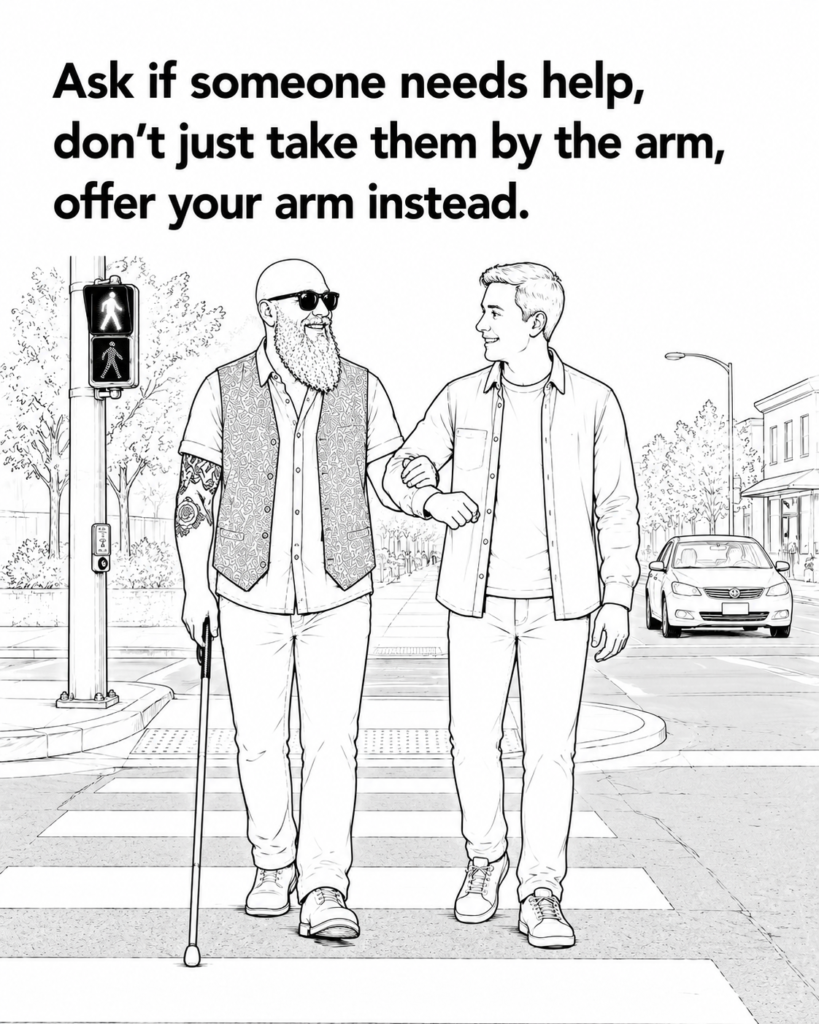
Rather than taking hold of their arm, offer yours instead.
Stand beside them and allow them to lightly hold your arm just above the elbow.
That simple position gives the person following you all the information they need. They can feel your body movements, adjust to changes in direction, anticipate steps and kerbs, and walk comfortably half a step behind without being pulled or pushed.
It also means they remain in control.
If they need to let go, they can.
If they need to stop, they can.
The guide isn’t leading someone helplessly.
They’re simply sharing information through movement.
Crossing a road is a good example.
If I’ve asked for assistance, don’t pull me across the street like a stage villain being led off. Let me hold your arm and walk at a natural pace. Tell me if there’s a kerb, a step, or uneven ground. That’s all I need.
The goal of good assistance isn’t to make a blind person dependent on you. It’s to help them remain independent without you.
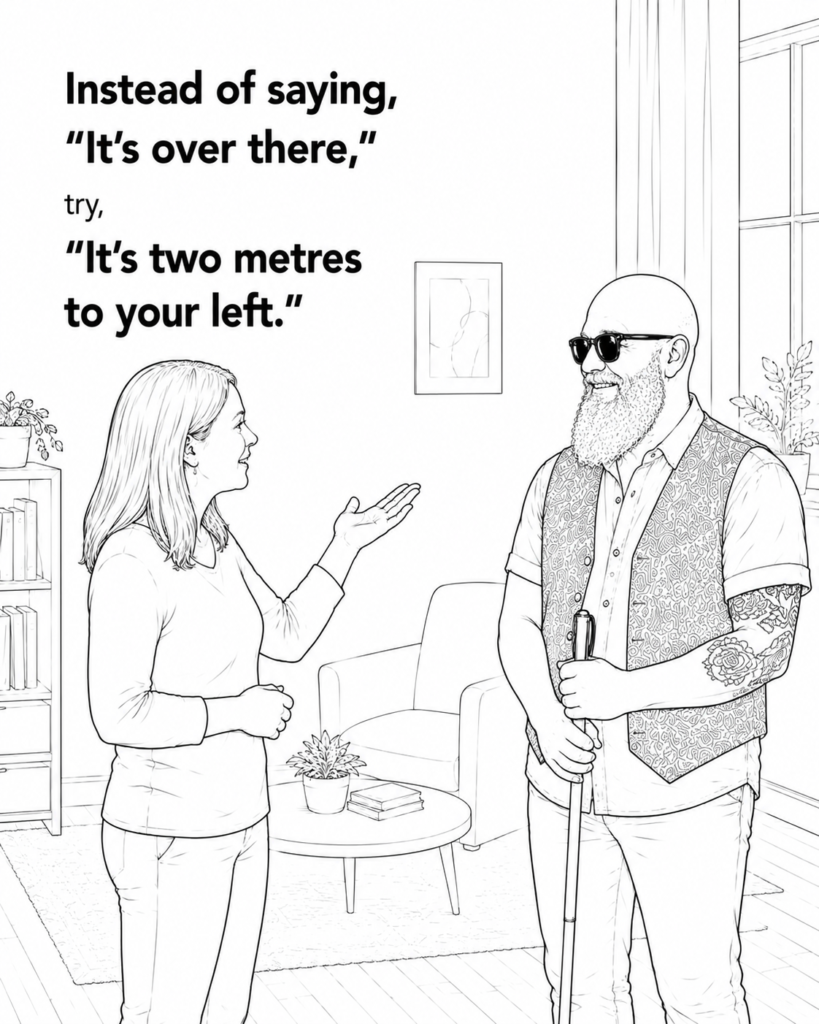
One of the phrases I hear most often is, “It’s over there.”
Usually those words are accompanied by an enthusiastic finger pointing towards the object in question. The trouble is that, unless your finger has suddenly learned to speak, it isn’t telling me very much.
For someone who can see, pointing is wonderfully efficient. Our eyes instantly translate a gesture into direction, distance and location without us even thinking about it. We don’t consciously calculate where someone is pointing; we simply know.
When you can’t rely on vision, all of that information disappears.
“Over there” could mean two metres away or twenty. It could be to my left, behind me, or directly in front of me. Without a visual reference, those two innocent words are about as useful as being told that the answer is “42.”
Fortunately, the solution is remarkably simple, and it doesn’t require long, complicated explanations. It merely asks us to replace pointing with describing.
Instead of saying, “It’s over there,” try saying, “It’s about two metres to your left,” or “Walk straight ahead until you reach the wall, then turn right.” Those few extra words provide the information that your pointing finger was trying to convey all along.
I’ve found that many blind people also find the face of a clock to be a useful way of describing direction. If you imagine the person standing in the centre of a clock face, twelve o’clock is directly ahead, three o’clock is to their right, six o’clock is behind them, and nine o’clock is to their left. Saying, “The chair is at two o’clock,” immediately gives me a direction. Add a distance, “about three metres away”, and you’ve painted a surprisingly accurate picture of where it is.
Of course, no single method works for everyone. Some people, including those with aphantasia who don’t naturally form mental images, may find other forms of description more useful. Others prefer landmarks or step-by-step directions. As with so many aspects of blindness, the best approach is simply to ask what works for the individual rather than assuming there is one right way.
It’s about communicating differently. A few carefully chosen words can replace an outstretched finger, and in doing so they preserve something far more valuable than convenience, they preserve independence.
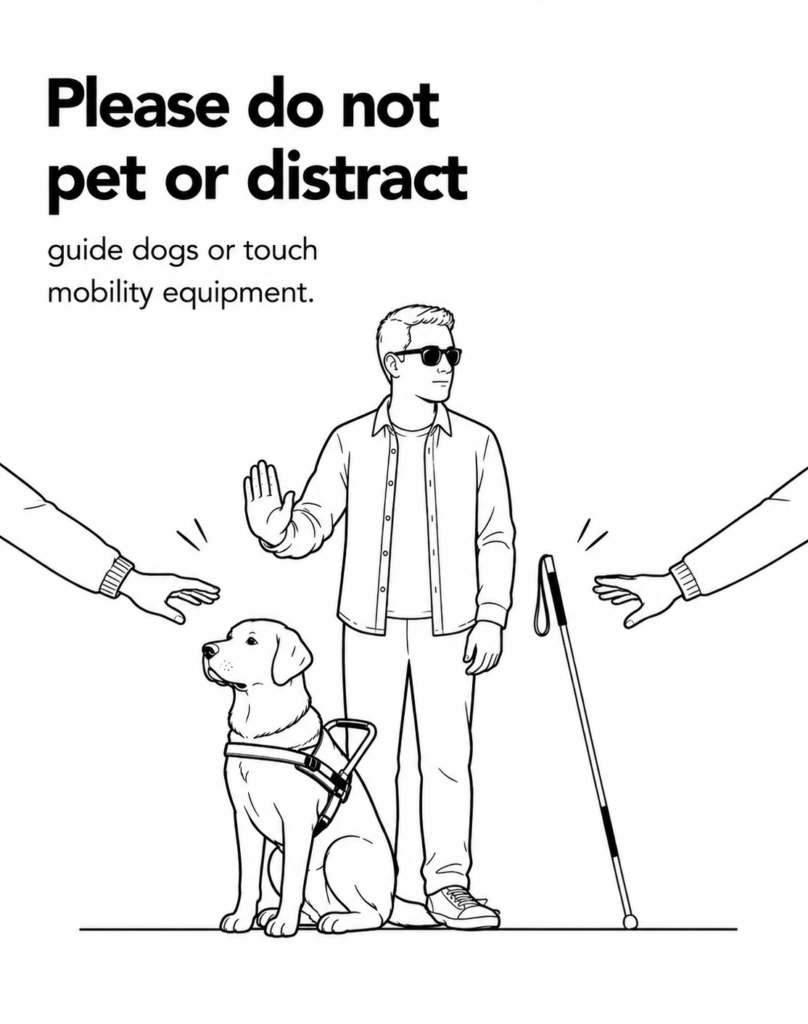
One of the first things people notice about me is my white cane. The same is true for guide dogs. Both attract attention and curiosity, and understandably so.
The important thing to remember is that neither is simply an object or a pet.
They are working.
My white cane isn’t just something I carry; it’s how I gather information about the world around me. Every sweep tells me where the footpath begins and ends, whether there’s a kerb ahead, a change in surface, or an obstacle in my way. If someone grabs it or moves it without asking, that flow of information is suddenly interrupted.
Guide dogs are no different. Although they are friendly, affectionate animals, when they’re wearing their harness they’re concentrating on keeping their handler safe. Calling to them, patting them, or offering them food can distract them at precisely the wrong moment.
If you’d like to meet a guide dog, simply ask. Most handlers are delighted to introduce their dogs once they’re off duty.
The same principle applies to any mobility equipment. Whether it’s a white cane, a guide dog, a wheelchair or a walker, these aren’t simply possessions. They are tools that make independence possible.
Treat them with the same respect you would any part of the person using them.
Leave a Reply