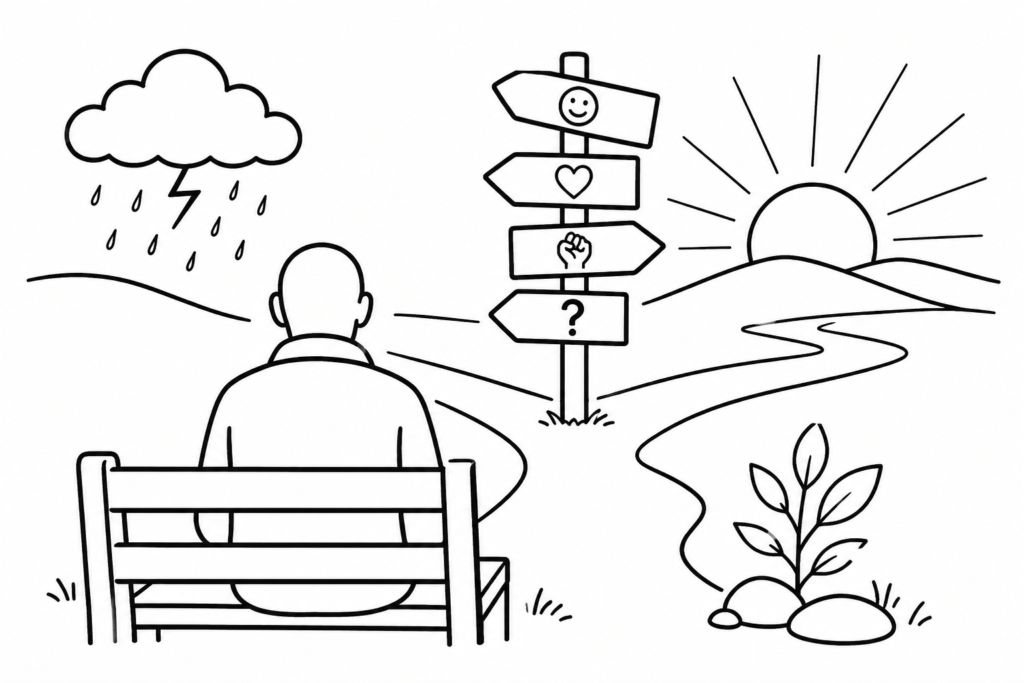
One of the longest-running questions in my own practice has been this: What is mindfulness actually for? Whenever life becomes difficult, whenever we are confronted by loss, uncertainty or injustice, the answer often seems to revolve around calmness. Stay grounded. Stay present. Stay regulated. Accept what is.
Underneath much of this advice lies the Buddhist concept of equanimity, and I think it is one of the most misunderstood aspects of practice. Equanimity is often mistaken for calmness, detachment or the ability to remain unaffected by life’s difficulties. It is none of those things. Equanimity does not mean we stop feeling grief, anger, fear or joy. It means we are not completely swept away by them. It is the capacity to remain present with our experience without being consumed by it.
A person with equanimity is not indifferent. They care deeply. They grieve deeply. They may even feel anger intensely when confronted by suffering or injustice. The difference is that their response is not dictated entirely by those emotions. Equanimity allows us to keep our balance while remaining fully engaged with life.
There is wisdom in all of the advice to stay grounded, stay present and accept what is. But I sometimes wonder whether we have confused the purpose of practice with one of its side effects. We seem to have arrived at the idea that the goal of meditation is to become calm and comfortable, and that if we remain uncomfortable, angry or unsettled, we must somehow be doing it wrong.
My own experience has been very different.
When I was diagnosed with myopic macular degeneration, meditation did not take away the grief. It did not remove the fear of an uncertain future. It certainly did not make me feel comfortable about losing my sight. There were days when I was angry, days when I was frightened and days when I wanted nothing more than to wake up and discover it had all been a mistake.
What practice offered was not comfort. It offered companionship. It gave me a way to remain present with my experience instead of constantly trying to escape it.
That distinction matters.
Many people hear the word acceptance and assume it means approval or resignation. It does not. I accept that I am losing my vision, but I do not approve of it. I accept that many disabled people are forced to live in poverty, but I do not approve of it. I accept that governments make decisions that make life harder for vulnerable people, but I most certainly do not approve of them.
Acceptance simply means seeing clearly what is already here.
Once we see clearly, we can respond appropriately.
Sometimes that response is grief. Sometimes it is compassion. Sometimes it is courage. And sometimes it is anger.
I have become increasingly uncomfortable with the suggestion that spiritual maturity means remaining calm at all times. Calmness can be useful, but it is not the highest expression of practice. A person can be calm and indifferent. A person can be calm and complacent. A person can be calm while turning away from the suffering of others.
Practice is not about becoming detached from life. It is about becoming intimate with it.
The Buddha did not promise a life free from difficulty. He did not teach a method for insulating ourselves from reality. He invited people to look directly at suffering and understand its causes. That requires courage far more than it requires tranquillity.
The longer I live with vision loss, the more convinced I become that mindfulness is not about feeling better. Sometimes it does help us feel better, and I am grateful for that. More importantly, it helps us see more clearly.
It helps us recognise when we are avoiding something that needs to be faced. It helps us stay present when life becomes painful. It helps us distinguish between what can be changed and what cannot. It helps us act from wisdom rather than impulse.
Most importantly, it helps us remain human in circumstances that might otherwise close our hearts.
The real question is not whether practice makes us calm.
The real question is whether practice helps us meet life honestly.
Because life will ask many things of us. It will ask us to grieve. It will ask us to let go. It will ask us to stand up for ourselves and for others. It will ask us to love despite uncertainty and loss.
No amount of meditation exempts us from those responsibilities.
If practice has any purpose at all, it is to help us meet them with courage and an open heart.
Leave a Reply