Most of my days are spent in the country, where life has its own rhythm and pace. The sounds are familiar, the pathways known, and the demands of the day generally unfold without too many surprises. Yet even here, I often find myself exhausted.
Simple tasks that once happened automatically now require planning, concentration, and attention. Finding things around the house, reading labels, managing technology, preparing meals, or navigating unfamiliar situations all demand a level of mental effort I never had to think about when my sight was intact.
The fatigue becomes even more apparent on the days I venture into the city.
Modern urban environments seem increasingly designed for speed rather than accessibility. Take my last trip into town. As usual, Shelley dropped me off before heading off to her own appointments, with plans to collect me a few hours later from an agreed meeting point.
I had a few errands to run and needed to get from one side of town to the other. It was a route I had walked many times before and knew well. Over the years, I have developed mental maps of places, carefully choosing routes that make use of the limited number of traffic lights and pedestrian crossings available.
Everything was going smoothly until I reached one of the busiest intersections in town.
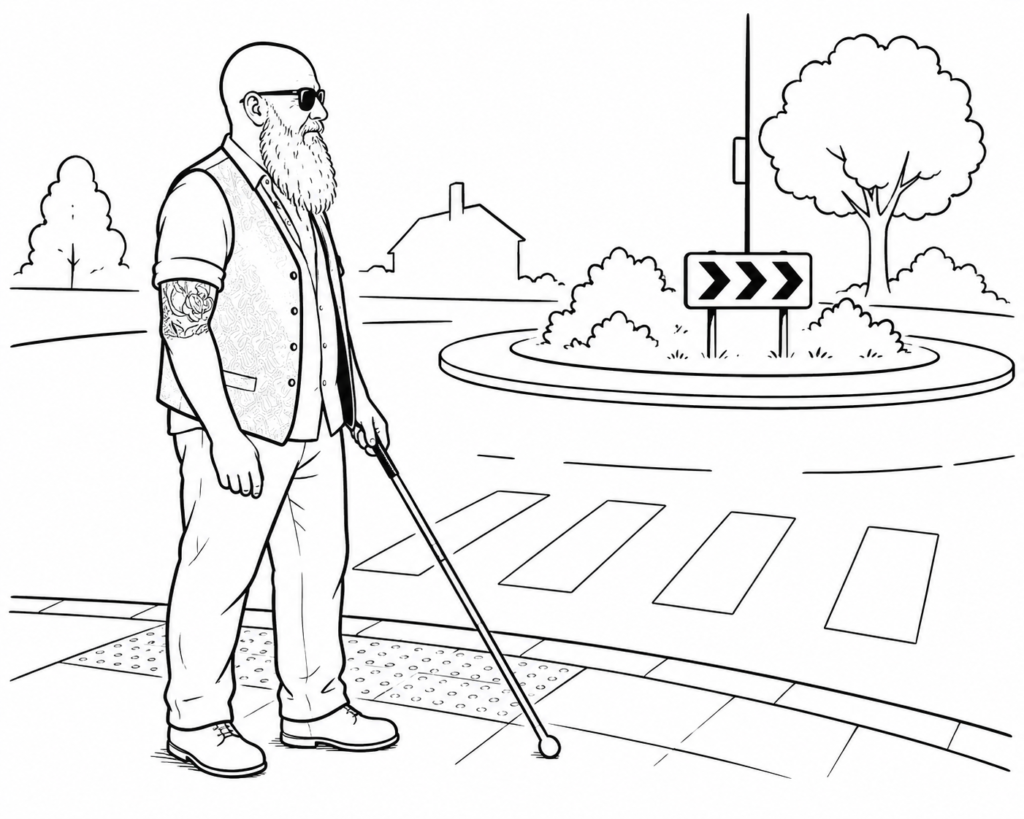
After waiting longer than expected for the familiar audible signal that tells me it is safe to cross, I realised something was wrong. The traffic lights had been switched off and the intersection had been converted into a temporary roundabout. For most people this would have been a minor inconvenience. For me, it created a barrier I could not safely negotiate.
The route I had carefully planned no longer existed.
For a moment I felt stranded. Not lost exactly, but cut off from the assumptions that make independent travel possible.
After standing there for a while trying to work out my options, I decided to turn left and continue along the footpath in the hope of finding another crossing point further down the road. Eventually I reached a T-junction, only to discover another crossing that offered no safe way through.
I found myself standing there, uncertain and increasingly stressed, trying to solve a problem that most people would barely notice.
Then I heard a voice from across the road.
“Are you okay?”
When I explained that I was trying to find a safe place to cross, the man came over and offered assistance. What struck me was not simply that he helped, but how he helped. He didn’t grab me or attempt to steer me where he thought I should go. Instead, he introduced himself and offered his elbow, allowing me to choose whether to accept his assistance and walk alongside him.
It was a small act of kindness, but one that restored my faith in humanity.
What stayed with me afterwards was not the inconvenience of being delayed. It was how much energy the whole experience had consumed. What appears to be a simple task, crossing a street, can become an unexpectedly stressful and energy-intensive undertaking when you have significant vision loss. It requires constant assessment, problem-solving, and vigilance. Every unexpected obstacle demands more concentration and more emotional energy.
Busy intersections, crowded footpaths, electric scooters, outdoor dining areas, construction zones, poorly marked hazards, and the constant flow of traffic create a landscape that requires relentless attention. Then there is the dreaded wet-floor sign, capable of appearing almost anywhere without warning.
By the time I return home, I am often completely exhausted, frequently with a pounding headache to accompany the fatigue.
For many people living with vision loss, this experience will sound familiar.
One of the great misconceptions about blindness and low vision is that if you cannot rely on your eyes, you simply use your other senses instead. In reality, those other senses require active attention. A sighted person walking through a busy street processes enormous amounts of information automatically. A person with vision loss often has to consciously gather information through hearing, touch, memory, spatial awareness, and constant problem-solving.
Where is that sound coming from?
Is that person talking to me?
Did I pass the doorway?
Have I crossed at the right point?
Has the environment changed since the last time I was here?
Every decision consumes energy.
Researchers call this increased cognitive load. Put simply, the brain is working harder for longer periods of time. Eventually that effort catches up with you.
Fatigue is not simply feeling tired. On some days I wake up feeling as though I have already spent my energy before the day has begun.
Sometimes it feels like mental fog. Concentration becomes difficult. Words disappear halfway through a sentence. Small decisions feel strangely overwhelming. Patience becomes a scarce resource. Sometimes it is physical. Muscles tighten, headaches develop, and bright light becomes unbearable. At other times it is emotional. Vision loss involves a continual process of adaptation. Every new challenge requires learning, adjustment, and acceptance. That emotional labour has a cost of its own.
For a long time, I treated exhaustion as something to overcome through determination. If I pushed harder, stayed busy, and refused to slow down, surely I could keep up with my former self. After all, that was how I had spent much of my working life in commercial kitchens. When service started, there was no time to be tired. You pushed on, found another gear, and kept going until the job was done. That mindset served me well in kitchens. It serves me far less well with vision loss.
Ignoring fatigue usually meant paying for it later. A busy day in town might leave me depleted for the following day. A week of overcommitting could require several days of recovery. Eventually I realised that fatigue was not the enemy. It was feedback. My body and mind were telling me something important about the amount of energy required to navigate the world.
That understanding changed how I approach daily life.
I have learned to make use of tools that reduce effort rather than increase it. Screen readers, audiobooks, voice assistants, magnification software, and simple organisational systems all help conserve energy. I plan more carefully than I used to and try not to stack too many demanding activities into the same day. If I know I have appointments in town, I leave space afterwards for recovery.
Most importantly, I have learned to rest before exhaustion becomes overwhelming.
This may be the hardest lesson of all. Many of us have spent our lives measuring our worth through productivity. We feel guilty when we slow down. We apologise for needing breaks. We compare ourselves to what we used to be able to do.
Vision loss has forced me to develop a different relationship with energy.
Rest is not giving up. Rest is maintenance.
Sometimes rest means sleep. Sometimes it means sitting quietly on the deck listening to birdsong. Sometimes it means meditation, a podcast, or an audiobook.
The goal is not simply to stop doing things. The goal is to replenish the mental and emotional reserves that daily life with vision loss continually draws upon.
One of the unexpected gifts of losing sight has been learning to pay closer attention to my own limits. Not every day needs to be productive. Not every opportunity needs to be accepted. Not every challenge needs to be overcome immediately.
Fatigue is not a sign of weakness. It is often evidence of the extraordinary amount of work people with vision loss are doing simply to participate in a world that was not designed with them in mind. If you live with vision loss and find yourself exhausted, know that you are not alone. The tiredness you feel is real. The effort you expend is real. And sometimes the wisest thing you can do is stop, rest, and offer yourself the same compassion you would offer to anyone else carrying an invisible load.
Leave a Reply