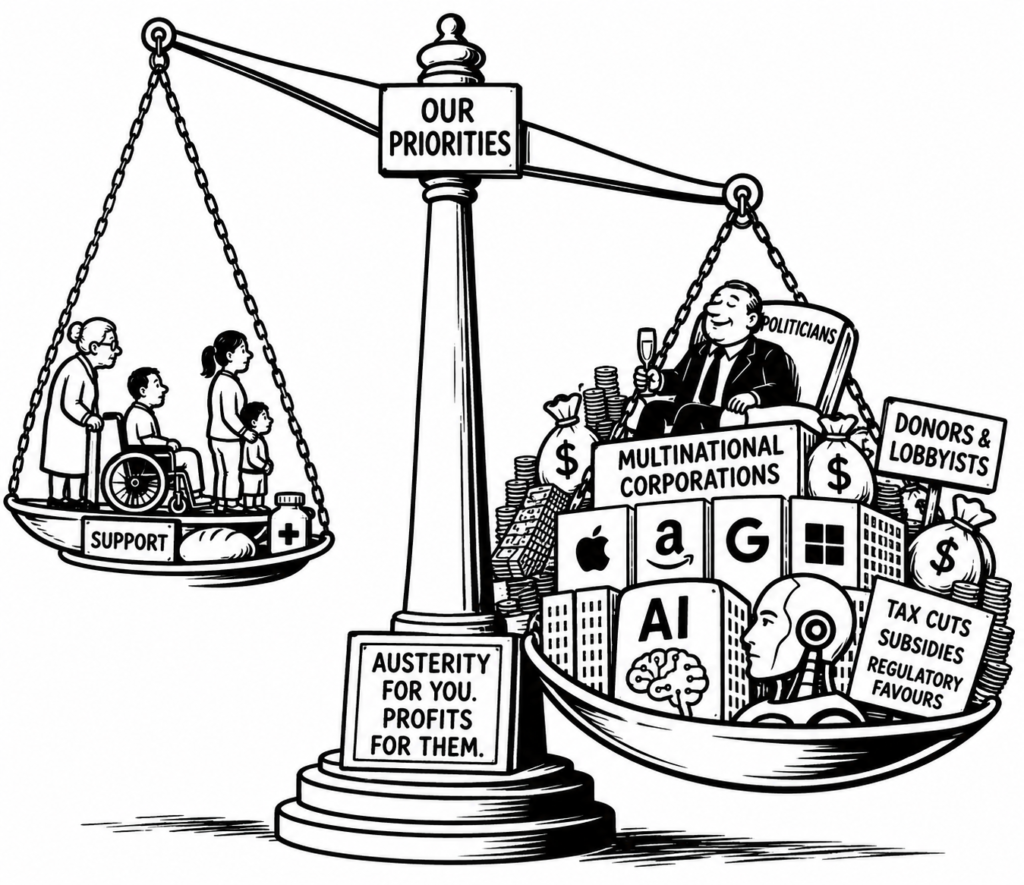
We are constantly told that New Zealand cannot afford compassion.
We cannot afford adequate support for disabled people. We cannot afford decent benefits for those trapped in poverty. We cannot afford stronger public services, affordable housing, functioning healthcare, or meaningful responses to inequality.
Yet somehow there is always money for tax cuts, corporate subsidies, political perks, consultant fees, and the endless rewards bestowed upon those already thriving.
This is not an economic problem.
It is a moral one.
We are living through what increasingly feels like the late stages of capitalism, where wealth and power have become so concentrated that they no longer even pretend to serve the common good. The language of public service has been replaced by the language of markets. Citizens have become consumers. Communities have become economic units. Human beings are valued not for their humanity but for their productivity.
Those who cannot produce enough, consume enough, or compete hard enough are quietly pushed to the margins.
The disabled.
The poor.
The elderly.
The sick.
The unemployed.
The inconvenient.
Austerity is sold as responsibility, but it often functions as something darker. It is a transfer of hardship downward. It asks those carrying the greatest burdens to carry more while those at the top continue accumulating wealth, influence, and privilege.
The cruelty is frequently hidden beneath spreadsheets and bureaucratic language.
No politician stands at a podium and announces that society should care less about disabled people. Instead, funding is reduced, eligibility tightened, services cut, and support systems gradually hollowed out. The outcome is the same. Suffering increases while responsibility is shifted onto individuals already struggling to survive.
Then comes the inevitable lecture about resilience.
The poor are told to budget better.
The disabled are told to become more independent.
The unemployed are told to try harder.
The public is told there is no alternative.
There is always an alternative.
What is missing is not money but political will.
What is missing is not economic capacity but moral courage.
Behind these policies lies a deeper poverty than anything experienced by those forced to use food banks or navigate degrading welfare systems.
It is a poverty of imagination.
A poverty of empathy.
A poverty of spirit.
It is the inability to recognise that a society’s greatness is measured by how it treats those with the least power.
Perhaps most disturbing is how normalised all of this has become.
Decades of media fragmentation, social media outrage cycles, and algorithmic manipulation have created populations that are simultaneously overwhelmed and distracted. Every scandal survives for a few days before disappearing beneath the next wave of content. Every outrage competes with a thousand others for attention.
The result is a form of collective political exhaustion.
People know something is wrong.
They feel the growing inequality.
They see public services deteriorating.
They witness politicians enjoying privileges unavailable to ordinary citizens while wealthy donors seem to enjoy unprecedented access to power.
Yet before any sustained resistance can form, attention shifts elsewhere.
The machinery moves on.
The cuts proceed.
The wealth accumulates.
The damage deepens.
Meanwhile, those making these decisions increasingly appear insulated from their consequences. They inhabit a world of parliamentary salaries, allowances, investments, directorships, and influential networks. They speak of sacrifice while rarely experiencing it themselves.
Arrogance flourishes when power is protected from accountability.
History offers countless examples of what happens when elites become convinced that their privilege is deserved, their success entirely self-made, and the suffering of others simply evidence of personal failure. Such societies eventually discover that inequality is not merely unfair, it is unstable.
No civilisation has ever maintained social cohesion indefinitely while concentrating wealth upward and abandoning solidarity downward.
The tragedy is that New Zealand once aspired to something better.
We believed that everyone deserved a fair go.
We believed that collective wellbeing mattered.
We believed that public institutions existed to serve people rather than markets.
Those values are not entirely gone, but they are under siege.
The greatest threat facing New Zealand today is not debt, deficits, or declining productivity.
It is the corrosion of our moral imagination.
It is the growing acceptance that some lives matter more than others.
It is the belief that wealth is virtue, poverty is failure, and compassion is a luxury.
A nation does not collapse when it runs out of money.
A nation begins to collapse when it runs out of conscience.


Leave a Reply